Robotics Data Collector: The Remote AI Opportunity Showing Nigerians Where the Future of Work Is Going
A few years ago, when someone said “remote job,” most people immediately thought of virtual assistance, customer support, social media management, software development or digital marketing.
Now, a very different category of remote work is beginning to appear.
Robotics Data Collector.
And one of the latest openings is available to people in Nigeria, alongside Kenya, Namibia, Morocco, Egypt and South Africa.
The role is fully remote and full-time, and while the job title sounds highly technical, the actual requirements reveal something much more interesting about where the AI economy is heading. (LinkedIn)
The opportunity is with The Global Talent Co., a company that connects global brands with talent across different markets.
The position was posted around 11 September 2026, and the listing currently identifies Nigeria as an eligible location. The employer has not published a salary, and there is no closing date stated in the available listing, which means interested candidates should treat it as an apply-early opportunity rather than waiting for a deadline. (Virtual Click Jobs)
But there is a bigger story here than one job vacancy.
Why does a robotics company need someone sitting at home with a smartphone?
Because robots need to learn from the real world.
An AI system can be trained on enormous amounts of text, images and computer-generated information, but physical intelligence is different.
A robot needs to understand things like:
How does a person pick something up?
What does a normal kitchen environment look like?
How does someone move around a room?
What happens when a person opens a cupboard, moves an object or interacts with another person?
How should a machine interpret human actions?
These are the kinds of real-world behaviours that AI companies need data for.
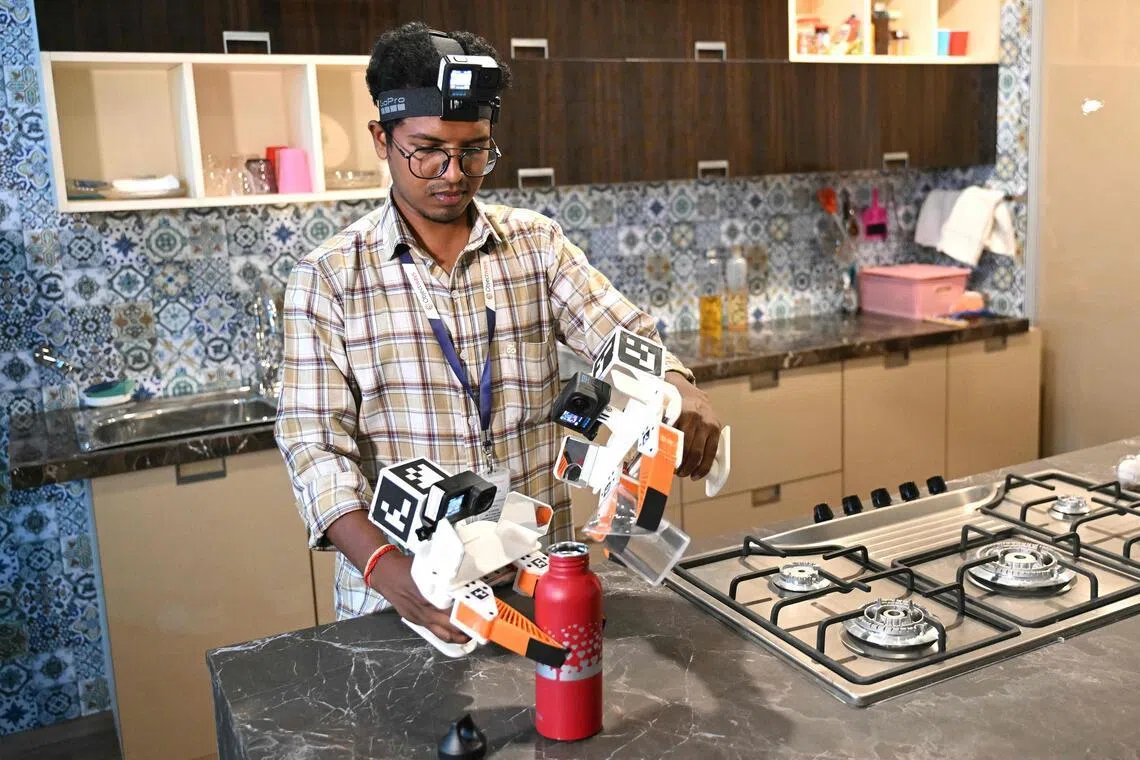
That is why this particular role asks contributors to record approximately four hours of video per day, following predefined household activities and project instructions. The recordings are then uploaded according to the project’s requirements. (LinkedIn)
In other words, the person collecting the data is helping create the raw material from which AI systems can learn.
And that is a very important distinction.
The future of AI will not only be built by people who develop AI models. It will also be built by people who create, collect, label, validate and manage the data those models depend on.
What exactly would you be doing?
The role is considerably more straightforward than the title might suggest.
According to the current listing, the contributor records everyday household activities using a smartphone or camera, follows a predefined list of tasks, maintains the required recording quality and uploads the completed material within the project’s timeline. (LinkedIn)
The basic requirements include:
A quiet indoor environment with minimal interruptions.
A clean and well-lit space suitable for recording.
A smartphone or camera capable of producing clear video.
Stable internet for uploading recordings.
The ability to follow detailed instructions and meet daily recording targets. (Virtual Click Jobs)
Notice what is missing.
The listing does not require you to be a robotics engineer.
It does not say you need to build robots.
It does not require advanced machine-learning programming.
Instead, the emphasis is on reliability, attention to detail, consistency, recording quality and the ability to follow protocols.
That tells us something important about modern AI employment.
AI is creating jobs around the technology, not just inside it
There is a tendency to look at AI and assume the only people who can benefit are software engineers, machine-learning researchers and data scientists.
That is becoming increasingly inaccurate.
An AI system is an entire production pipeline.
Someone has to collect the data.
Someone has to annotate it.
Someone has to check its quality.
Someone has to organise it.
Someone has to document the process.
Someone has to test whether the model performs correctly.
Someone has to manage the workflow.
Someone has to communicate with clients.
Someone has to implement the resulting technology inside a business.
And someone has to train people to use it.
This robotics data-collection role sits somewhere inside that much larger ecosystem.
That is why I would not look at this vacancy simply as “another remote job.”
I would look at it as a signal.
The AI economy is creating new categories of work that did not exist in the mainstream job market a few years ago.
And this matters particularly for African professionals
There is another interesting part of this opportunity.
The employer is not limiting the project to North America or Western Europe.
Nigeria is explicitly included alongside several African countries. (Virtual Click Jobs)
That matters because AI companies need data that represents different environments, behaviours and populations.
If AI is going to operate in the real world, the real world cannot be represented by one country, one culture or one type of household.
African participation in AI data projects can therefore become part of the broader AI infrastructure.
This does not mean every African person should suddenly become a data collector.
It means professionals should start paying attention to the different layers of the AI economy.
There are opportunities beyond “learn Python and become an AI engineer.”
What should you learn from this if you are looking for remote work?
The first lesson is simple:
Do not define remote work too narrowly.
If you have been searching only for virtual assistant jobs, customer support jobs or social media positions, you may be missing emerging categories.
Search for terms around:
AI data collection.
Data annotation.
AI training.
Computer vision.
AI evaluation.
Model testing.
Data quality.
AI operations.
Research assistance.
Human-in-the-loop AI.
AI content evaluation.
Robotics support.
These roles can require very different skills from traditional tech jobs.
And some are designed specifically around human interaction with AI systems.
The second lesson: ordinary skills can become valuable inside extraordinary industries
Look at the requirements for this role.
You need to follow instructions.
You need to be consistent.
You need attention to detail.
You need basic technology competence.
You need reliable internet.
You need to meet targets.
These sound like ordinary workplace skills.
But when they are applied to an AI data pipeline, they become commercially valuable.
This is something I often think businesses and job seekers underestimate.
A skill does not become valuable only because it sounds complicated.
Sometimes the opportunity comes from applying a simple skill inside a growing industry.
Someone who is extremely organised, careful and process-driven may find a place in AI operations even without being a machine-learning engineer.
Someone with strong documentation skills can work around AI projects.
Someone with customer-support experience can move into AI evaluation or conversational AI testing.
Someone with research experience can support data and model evaluation.
Someone with project-management experience can coordinate AI implementation.
The question is not always:
“Do I have an AI degree?”
A better question is:
“Which part of the AI value chain can my existing skills plug into?”
If you want to apply for this opportunity, don’t submit a generic CV
This is where many applicants make a mistake.
They see “AI” in a job description and immediately send a CV filled with every skill they have ever learned.
Don’t.
For this particular role, your application should demonstrate that you can follow processes and produce consistent, high-quality work.
If you have experience with data collection, research, fieldwork, content moderation, quality assurance, documentation, laboratory work, technical projects, photography, video production or other structured tasks, bring those experiences forward.
If you have worked on projects where accuracy mattered, explain that.
If you have experience using cameras, smartphones, recording equipment or technical devices, mention it.
If you have experience following standard operating procedures, meeting daily targets or submitting work according to strict guidelines, make that visible.
The employer is not simply looking for someone who owns a smartphone.
They are looking for someone who can be trusted to produce usable data consistently.
Your environment matters too
This is one of the unusual parts of the application.
Your home becomes part of the working environment.
The listing specifically asks for a quiet indoor space, suitable lighting, minimal interruption and a stable internet connection. (LinkedIn)
So before applying, ask yourself honestly:
Can I record without constant background noise?
Do I have enough space to complete the assigned activities?
Can I consistently meet approximately four hours of recording per day?
Can my internet connection handle uploading large video files?
Do I have a device capable of producing clear recordings?
Can I follow instructions precisely without improvising when the project requires consistency?
Those practical questions can matter just as much as your CV.
There is also a privacy question we should not ignore
Whenever a job involves recording inside your home, applicants should slow down before accepting anything.
You should understand exactly:
What you are being asked to record.
Whether other people can appear in the recordings.
How the footage will be used.
Where the data will be stored.
How long it will be retained.
Whether you need consent from anyone appearing in the recordings.
What personal information must not be captured.
And what platform you are expected to upload the material through.
AI creates enormous opportunities, but data privacy is part of the opportunity too.
Never give an employer passwords, OTPs, banking PINs or unnecessary personal credentials simply because a role involves technology.
And always verify that you are applying through the legitimate employer/application channel.
The bigger opportunity for businesses
There is another side to this story that interests me even more.
If companies are spending significant resources collecting real-world data to train intelligent systems, businesses will increasingly need people who understand how to turn operational activity into usable data.
That means African companies should start asking different questions about their own operations.
What customer data are we already generating?
What processes are currently undocumented?
What information could be structured?
Which repetitive activities could be automated?
Where are employees spending time on manual work?
What data would an AI system need in order to perform this task reliably?
What safeguards would be required before giving AI access to this process?
These are no longer futuristic questions.
They are business strategy questions.
And this is where BridgePoint sees an opportunity
At BridgePoint Growth & Consulting, we don’t look at AI simply as a technology trend.
We look at it from the perspective of business transformation.
A company does not become competitive because it has ChatGPT.
It becomes competitive when it understands where technology can improve revenue, customer experience, operations, decision-making and productivity.
For some companies, that may mean AI-powered customer support.
For another, it may mean sales automation.
For another, it could mean data intelligence.
For another, it could mean workflow automation.
And for another, it may mean preparing employees for an AI-enabled workplace.
The robotics data collector opportunity is a small example of a much bigger transition.
Work is being reorganised around data, automation and intelligent systems.
Businesses that understand this early will have an advantage over businesses that wait until AI has already changed their industry.
At BridgePoint, we help businesses think through these transitions practically — from growth strategy and digital transformation to partnerships, talent and business development.
If your organisation is trying to understand how AI can improve its operations or create new growth opportunities, BridgePoint Growth & Consulting can help you turn the idea into a practical strategy.
One more thing for Nigerian job seekers
Don’t wait until the perfect AI job appears before you start preparing.
Start building evidence now.
Take a small data project.
Learn how AI datasets are created.
Understand annotation and quality control.
Experiment with AI tools.
Learn basic data handling.
Build a simple portfolio.
Document your projects.
Improve your CV.
And most importantly, learn how to explain what you can actually do.
Because the AI economy will not only reward people who know the latest tools.
It will reward people who can combine technology with reliability, judgement, communication, execution and problem-solving.
That combination is much harder to replace.
The opportunity at a glance
Role: Robotics Data Collector Company: The Global Talent Co. Work arrangement: Fully remote Employment: Full-time Eligible locations: Nigeria, Kenya, Namibia, Morocco, Egypt and South Africa/Johannesburg Posted: Around 11 September 2026 Salary: Not disclosed Deadline: Not stated Main task: Record approximately four hours of everyday household activity videos per day according to predefined instructions Equipment: Smartphone or camera + stable internet Experience: The listing focuses primarily on reliability, recording quality and ability to follow instructions rather than advanced robotics qualifications. (LinkedIn)
Application: View the current Robotics Data Collector listing
Because job listings can change quickly, confirm that the position is still accepting applications before submitting your information.
Stay closer to opportunities like this
One of the biggest problems with remote work and business opportunities is not that opportunities don’t exist.
It is that people often hear about them too late.
That is one of the reasons BridgePoint created The Wealth Movement — a WhatsApp community where founders, professionals, entrepreneurs and opportunity-seekers can access relevant funding opportunities, jobs, business opportunities, partnerships, growth insights and useful resources.
If you want to hear about opportunities like this without constantly searching the internet yourself, join The Wealth Movement on WhatsApp.
The goal isn’t quick money.
It is better information, better positioning and better opportunities.
Sources
- The Global Talent Co./current job listing — role details and requirements. (LinkedIn)
- Current job-market listings cross-checking Nigeria eligibility, full-time status and posting date. (Makely)
- CNTXT AI robotics data-collection listing — useful context on the broader robotics-data ecosystem and the kinds of hardware, sensor and data-quality work involved. (LinkedIn)
Need help preparing for the AI economy?
BridgePoint Growth & Consulting helps businesses and professionals strengthen digital capabilities, growth systems, talent strategy and practical AI adoption.
Book a Strategy Call