On Monday, September 14, something significant is scheduled to happen in Nigeria’s capital market.
The Dangote Petroleum Refinery and Petrochemicals public offer is expected to open to eligible investors, giving the public an opportunity to become shareholders in one of Africa’s most important industrial assets.
Reuters reports that the offer is designed to raise about ₦2.15 trillion, or approximately $1.63 billion, with the subscription period scheduled for September 14 to October 13, 2026. Trading is expected to begin later in November, subject to the applicable listing timetable.
The official IPO information platform confirms an offer price of ₦525 per share and a minimum subscription of 10 shares, meaning an investor can apply from ₦5,250.
At first glance, this looks like an investment story.
But it is much bigger than that.
It is a story about whether African capital can finance African infrastructure.
It is a story about whether ordinary Nigerians and other eligible investors can participate directly in the ownership of a major industrial asset.
It is a story about the evolution of Nigeria’s capital market.
And it is a story about what happens when one of Africa’s biggest privately built industrial projects becomes part of the public market.
The offer at a glance
Before discussing the bigger implications, it is important to get the basic facts right. Several figures have circulated online, so investors should rely on the official offer information and prospectus rather than social-media summaries.
| Item | Current offer information |
|---|---|
| Issuer | Dangote Petroleum Refinery and Petrochemicals FZE |
| Shares offered | 4.1 billion ordinary shares |
| Offer price | ₦525 per share |
| Minimum subscription | 10 shares |
| Minimum amount | ₦5,250 |
| Potential proceeds | Approximately ₦2.15 trillion / $1.63 billion if fully subscribed |
| Opening date | 14 September 2026 |
| Closing date | 13 October 2026 |
| Proposed market | Main Board of the Nigerian Exchange |
The official IPO platform also makes an important distinction: the IPO website provides public information and routes investors to approved subscription channels. It does not itself process subscriptions, KYC, payments or allotments.
This is not an ordinary IPO
The Dangote Refinery is not a startup raising its first major round of funding.
It is an operating industrial business.
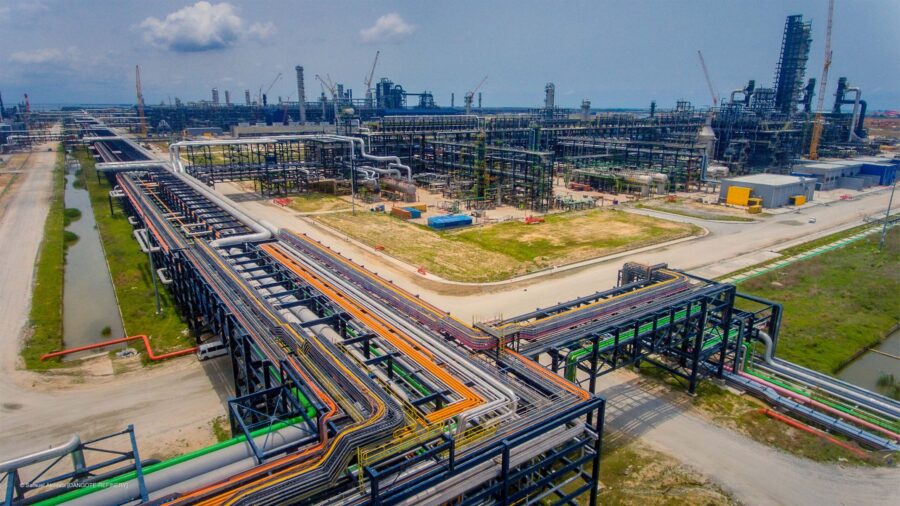
The refinery began operations in 2024 and currently has a crude distillation capacity of about 700,000 barrels per day. Dangote’s own refinery materials describe an integrated industrial platform that brings together refining, petrochemicals, storage, marine infrastructure, pipelines, logistics and dedicated power.
The company is also pursuing an expansion toward approximately 1.4 million barrels per day.
Reuters reports that the expansion programme is estimated at about $14.3 billion and is targeted for completion by 2029.
That changes the way this transaction should be viewed.
The IPO is not simply raising money for a company that hopes to become something in the future.
It is opening the ownership of an already-established industrial asset while the business is preparing for another major phase of expansion.
That creates a very different capital-market conversation.
Why is Dangote raising $1.6 billion?
The short answer is growth.
The longer answer is that large industrial expansion requires a large and diversified capital base.
Refineries require equipment, maintenance, working capital, technology, storage, logistics and continuous investment in reliability and capacity.
Expansion also requires financing over several years, not simply one injection of cash.
The planned increase from 700,000 barrels per day to approximately 1.4 million barrels per day is therefore much more than a capacity upgrade. It represents another major stage in the development of the business.
The public market gives Dangote another channel through which capital can participate in that growth.
And that is important for the wider Nigerian economy because it demonstrates how a large African industrial business can use the capital market to support expansion.
The most interesting part may be who Dangote wants as investors
One of the defining features of this transaction is its emphasis on broad participation.
The official platform sets the minimum subscription at just 10 shares, or ₦5,250 at the ₦525 offer price.
The company has also described the transaction as an opportunity for Nigerians, the Nigerian diaspora and Africans more broadly to participate in the ownership of the industrial asset.
That matters because ownership of major infrastructure has traditionally felt distant from ordinary citizens.
You could use the refinery’s products.
You could follow its expansion.
You could watch its impact on Nigeria’s economy.
But direct ownership was a different matter.
A public offer changes that possibility for eligible investors.
The fact that someone can start with ₦5,250 does not mean that everyone should invest ₦5,250. The important question is whether the investment fits the person’s objectives, risk tolerance, financial position and investment horizon.
The valuation question matters
A major company can be strategically important and still be expensive at a particular price.
That is one of the most important distinctions investors need to make when looking at this IPO.
The scale of the refinery is extraordinary. But size alone does not tell an investor whether a share is attractively priced.
Investors need to consider the company’s earnings, cash generation, capital requirements, debt, expansion costs, operating risks and the assumptions behind its future growth.
In other words, there are two separate questions:
Is this an important company?
Is this an attractive investment at the offer price?
Those questions are related, but they are not the same.
That is why the prospectus matters more than excitement around the size of the transaction.
The refinery has already changed Nigeria’s energy conversation
Nigeria is one of Africa’s major oil-producing countries, yet it historically depended heavily on imported refined petroleum products.
The Dangote Refinery was built to change part of that equation by increasing domestic refining capacity and creating an integrated export-oriented refining and petrochemicals platform.
Its scale means developments at the refinery can have implications for:
- Domestic fuel supply
- Refined-product imports and exports
- Domestic crude demand
- Foreign-exchange flows
- Petrochemical production
- Industrial development
- Logistics and marine services
- Employment and skills
- Government revenue and the wider tax base
The business has also moved sharply into profitability. Reuters reported that the refinery recorded an after-tax profit of about $1.82 billion in the first half of 2026, compared with a $476 million loss for all of 2025.
That is a significant turnaround, but it should not be interpreted as a guarantee of future returns for shareholders.
Refining is exposed to global energy prices, supply disruptions, margins, crude availability, regulation and other market conditions. Investors therefore need to study the company’s longer-term economics rather than relying on one strong reporting period.
There is another story underneath the IPO: Nigeria needs capital
This may be the most important lesson.
Nigeria has enormous infrastructure and industrial needs.
Roads. Energy. Manufacturing. Logistics. Agriculture. Technology. Healthcare. Industrial processing.
Many projects in these sectors require more capital than government budgets alone can comfortably provide.
That makes capital markets increasingly important.
If the Dangote offering performs well, it could show that a large African industrial company can mobilise substantial domestic and regional capital from institutional and retail investors.
That matters beyond Dangote.
It could encourage other large African businesses to consider public markets as a credible source of expansion capital.
Can Africa finance itself?
This is one of the most interesting questions raised by the transaction.
Africa has significant pools of domestic savings. Pension funds manage long-term capital. Banks hold deposits. Institutional investors allocate capital. Individuals save and invest through different channels.
Yet major infrastructure and industrial projects across the continent have often depended heavily on foreign capital.
The bigger question is whether more African savings can become African investment capital.
If that happens at meaningful scale, the implications could extend beyond one IPO into financial inclusion, industrialisation and the depth of African capital markets.
The opportunity is bigger than one refinery
There is another part of this story that businesses should pay attention to.
When a major company raises billions to expand, the money does not simply disappear into one project. It moves through an ecosystem.
Large industrial expansion can create demand for:
- Engineering and construction
- Industrial equipment and components
- Procurement and supply services
- Logistics and transportation
- Technology and software
- Cybersecurity and data services
- Maintenance and technical support
- Professional training
- Consulting and project management
- Financial and insurance services
- Environmental and compliance services
This is why businesses should not only follow how much capital a company raises.
They should follow what the capital will create.
There is a major lesson here for Nigerian SMEs
One of the biggest mistakes small businesses make is looking at a large company and asking:
“How can I sell to Dangote?”
That question is too narrow.
A stronger business-development question is:
For example, an expanding industrial operation may need more procurement partners, logistics providers, software systems, technical contractors, training providers, compliance advisers and professional services.
The opportunity may not be a direct contract with the refinery itself. It may be a contract with a company that supplies the refinery, a contractor working on an expansion project, or another business responding to increased industrial activity.
That is a much broader way to think about business development.
Big projects create smaller opportunities around them.
What entrepreneurs should learn from this IPO
There is a powerful business-development principle here.
When you see a company raising significant capital, do not only ask:
“What are they going to do with the money?”
Ask:
“Who will they need to help them do it?”
That question can reveal an entire ecosystem of suppliers, partners, contractors and service providers.
For founders, this is where business-development intelligence becomes useful. Capital announcements are often signals of future demand.
What investors should examine before subscribing
This article is not an investment recommendation. If you are considering participating in the IPO, the official prospectus should be your starting point.
- The company’s financial performance. Study revenue, profit, margins, cash flow, debt and other financial indicators across the available reporting periods. Do not rely on one headline number.
- The valuation and offer price. A strong company can still be an expensive investment. Understand what the offer price implies about the business and the assumptions supporting that valuation.
- The expansion plan. The move toward 1.4 million barrels per day is substantial. Understand the capital required, timeline, execution risks and expected economics.
- Exposure to energy-market conditions. Refining profitability can be affected by crude prices, product prices, refining margins, supply disruptions and international market conditions.
- Regulation. Energy is a heavily regulated industry. Policy, pricing, taxation, environmental and other regulatory changes can affect the business.
- Liquidity after listing. Understand that being listed does not mean a share can always be sold instantly at the price you want.
- Dividend expectations. Dividends are not guaranteed. The official IPO information notes that dividends depend on profitability, cash requirements and the Board’s decisions.
- The prospectus and risk factors. Do not make an investment decision based only on headlines, social-media posts or WhatsApp messages. Read the official documentation and seek professional advice where necessary.
Beware of IPO scams
A major public offering naturally attracts scammers.
The official Dangote IPO platform has published specific fraud guidance, and investors should take it seriously.
The official platform says it will never ask for your PIN, password or OTP. It also warns that legitimate subscription payments should not be made to a personal account.
Be especially cautious about:
- WhatsApp “agents” asking you to pay them directly
- Fake subscription websites
- Personal bank accounts
- Requests for OTPs or passwords
- Unverified investment forms
- People promising guaranteed returns
- People claiming they can secure special allocations
- Social-media accounts pretending to be official IPO channels
Do not send it. Go directly to the official IPO platform and verify the approved subscription channel before taking any action.
The safest rule is simple: if the channel is not listed on the official IPO website, do not use it.
What this could mean for Nigeria’s stock market
The impact could extend well beyond Dangote.
If the offering is successful and the company is subsequently listed as planned, the transaction could materially increase the size and visibility of Nigeria’s equity market.
A company of this scale could attract greater attention from:
- Institutional investors
- Retail investors
- Foreign investors
- Pension funds
- African investment funds
- Research analysts
- International financial institutions
That visibility matters.
A deeper market with more large companies can create more opportunities for investors while giving African businesses another route to raise long-term capital.
But the real test will not end when the subscription window closes.
Success should not be measured only by how much money is raised
A successful IPO is not simply:
“The company raised $1.6 billion.”
There are bigger questions.
- Was the capital deployed effectively?
- Did the expansion deliver the expected results?
- Did the company maintain strong governance?
- Did investors receive clear and timely information?
- Did the stock develop healthy liquidity?
- Did the business create long-term shareholder value?
- Did the transaction strengthen confidence in Nigeria’s capital markets?
Those questions will matter long after the offer closes.
What other African businesses should learn
The Dangote IPO provides an important lesson for ambitious African companies.
At some point, growth requires serious capital.
A company can bootstrap its early stages. It can raise money from founders. It can take loans. It can bring in private investors.
But when the ambition becomes large enough, public markets can become part of the conversation.
That means founders should begin thinking much earlier about:
- Corporate governance
- Reliable financial reporting
- Audited accounts
- Compliance
- Investor relations
- Transparent ownership structures
- Strong management systems
- Capital-market readiness
You do not prepare for an IPO six months before you want one.
You build the company in a way that can eventually withstand serious investor scrutiny.
The BridgePoint Perspective
At BridgePoint Growth & Consulting, we look at the Dangote IPO from a broader business-development perspective.
The headline is a potential $1.63 billion capital raise.
But underneath that headline are several important developments:
- African capital is being invited into a major productive asset.
- Nigerian businesses are becoming more sophisticated in their capital strategies.
- Large industrial projects can create entire ecosystems of suppliers and partners.
- Investment readiness is becoming a meaningful growth capability.
- The scale of African business is changing.
For entrepreneurs, this means you should start building businesses that can attract serious capital.
That requires stronger governance, better financial systems, clearer strategy, reliable reporting, professional management, credible partnerships and a business model that can scale beyond the founder.
At BridgePoint, we help businesses strengthen their positioning, growth strategy, partnerships, business development and investment readiness so they can move from simply operating a business to building an organisation capable of attracting serious opportunities.
What entrepreneurs should do differently
The Dangote story should challenge the way many founders think about growth.
Do not only ask:
“How do I get more customers?”
Ask:
Would your records be ready?
Would your governance be credible?
Would your financial statements be reliable?
Would an investor understand your business within a reasonable amount of time?
Would you know exactly what additional capital would accomplish?
Would you have the management capacity to deploy it?
Would the company still function if you were no longer personally involved in every decision?
Those questions force you to think beyond survival.
They force you to think about institution-building.
Final takeaway
The Dangote Refinery IPO is more than an opportunity for investors to buy shares.
It is a test of something much bigger:
The answer will matter.
For investors, the lesson is to understand what you are buying rather than being carried away by the excitement surrounding the offer.
For entrepreneurs, the lesson is to build businesses that can eventually become investment-ready.
For SMEs, the lesson is to look beyond the headline and identify the supplier, partnership and service opportunities created by large investments.
For Nigeria, the opportunity is to demonstrate that its capital market can help finance industrial growth at continental scale.
And for Africa, perhaps the most important question is the simplest:
That is the bigger story behind the Dangote IPO.
Work With BridgePoint
If your business needs support with growth strategy, investment readiness, strategic partnerships, business development, market positioning or capital-readiness planning, BridgePoint Growth & Consulting can help you build the structure required for your next stage of growth.
Building people. Growing businesses. Creating opportunities.
Join The Wealth Movement
If you want to stay informed about investment opportunities, funding, business opportunities, partnerships and growth intelligence, join The Wealth Movement on WhatsApp, powered by BridgePoint Growth & Consulting.
The goal is not to chase every investment or opportunity. It is to understand the opportunity before making a decision.
Join The Wealth Movement →Official & Research References
- Dangote Refinery IPO — Official Public Information Platform — offer price, minimum subscription, dates, investor guidance and safety information.
- Official Approved Subscription Channels — approved Receiving Agents and Electronic Application Channels.
- Official Dangote IPO Fraud & Security Guidance — PIN, password, OTP and payment-scam warnings.
- Dangote Petroleum Refinery — Official Website — refinery capacity, industrial ecosystem, operations and expansion information.
- Dangote Investor Centre — Petroleum Refinery — business overview and investor-relations information.
- Reuters — Dangote Refinery plans $14.3B expansion as it signs IPO documents — offer size, expansion plan, capacity and first-half 2026 profit.
- Punch — Dangote Refinery IPO: What Investors Need to Know — offer structure and investor considerations.
- BusinessDay — Dangote IPO coverage — Nigerian capital-market and valuation context.
Important: This article is for educational and business-information purposes only and is not investment advice. Investing in shares involves risk; share values can rise or fall and investors may lose some or all of their invested capital. Prospective investors should read the official prospectus, consider their own circumstances and risk tolerance, and consult a licensed stockbroker or financial adviser where necessary. Use only subscription channels listed on the official Dangote IPO platform.